

SIRA CCTV Standards in the UAE: What’s Updated in 2026
Published On: September 9, 2026
CCTV compliance is a critical obligation for firms working in Dubai. The regulatory authority of the security industry, SIRA, was formed as per the Dubai Law No. 12 of 2016 and governs the security sector. Given the dynamic nature of SIRA’s requirements, it is essential to ensure your surveillance systems comply at all times in order to avoid inspections, fines and operational difficulties.
This guide is useful for business owners, facility managers, and organisations evaluating security system installers and ELV companies in Dubai.
Contents
What Are SIRA Regulations
SIRA is the government authority responsible for regulating Dubai’s security industry. Under Law No. 12 of 2016, it establishes and regularly updates security standards, licenses security service providers and regulates specified security devices and equipment.
The requirements apply to relevant establishments and security service providers operating within Dubai. SIRA is responsible for monitoring the compliance of the technical specifications of the preventive security systems that include CCTV and other electronic security methods.
The existing technical framework operates under the Preventive Systems Manual that was approved through Administrative Resolution No. 13 of 2025. The manual specifies the minimum technical specifications and requirements that should be implemented in the establishments regulated by these rules.
Updated Camera & Technical Requirements
The current SIRA requirements cover more than camera resolution. Image quality, outdoor protection, recording performance, network design and storage all form part of a compliant CCTV installation.
Minimum Resolution Requirements
SIRA requires cameras to provide at least 1080p Full HD resolution. Recording devices must also support at least 1080p Full HD recording, while single-camera live viewing must provide at least 1080p Full HD. Live viewing must operate at a minimum of 25 frames per second per camera.
The manual also specifies a minimum 48 dB signal-to-noise ratio. For identification applications, exceptional cases may require at least 300 pixels per metre, subject to SIRA approval. This shows why camera positioning and image quality are just as important as megapixel ratings.
Weatherproofing & Build Standards
Outdoor cameras or their enclosures must have a minimum IP66 rating for continuous operation in outdoor environments. Cameras facing direct or reflected natural or artificial light must also provide WDR of at least 110 dB or equivalent.
Where cameras are installed at a height of 4 metres or above, they must have remote zoom and focus capabilities. Cameras must also be designed for continuous operation and should not be concealed from view.
Network & System Standards
SIRA requirements also address the supporting network infrastructure. Security systems must use a dedicated private network, with appropriate redundancy and resilience. Where more than 200 devices are connected, network management and segmentation requirements become particularly important.
Recording systems must be capable of handling live viewing, recording and playback simultaneously without negatively affecting performance. Recording devices must also have 20% additional capacity, while recorded footage should be transferable to standard storage media.
Storage, Retention & Data Security
Recording retention depends on the applicable facility and requirements. The current SIRA manual specifies, in its general recording requirements, no less than 31 days for the specified non-continuous recording configuration, together with minimum recording performance requirements. Certain sectors can have longer retention periods.
Businesses should therefore calculate storage based on camera count, resolution, frame rate, recording mode and the retention period applicable to their facility. Access to security systems should also be restricted to authorised personnel to reduce the risk of tampering or unauthorised access.
Compliance Process and Who Needs to Comply
SIRA compliance is particularly relevant to establishments covered by Dubai’s preventive security requirements, including specified vital sectors, important complexes and other regulated facilities. The applicable requirements depend on the type and use of the premises.
Sectors Required to Install Compliant CCTV
The following types of establishments commonly fall within SIRA’s CCTV requirements:
- Hotels and serviced apartments
- Shopping malls and entertainment centres
- Banks and financial institutions
- Healthcare facilities
- Warehouses and logistics facilities
- Petrol/gas stations
Specific camera locations and viewing requirements vary by sector.
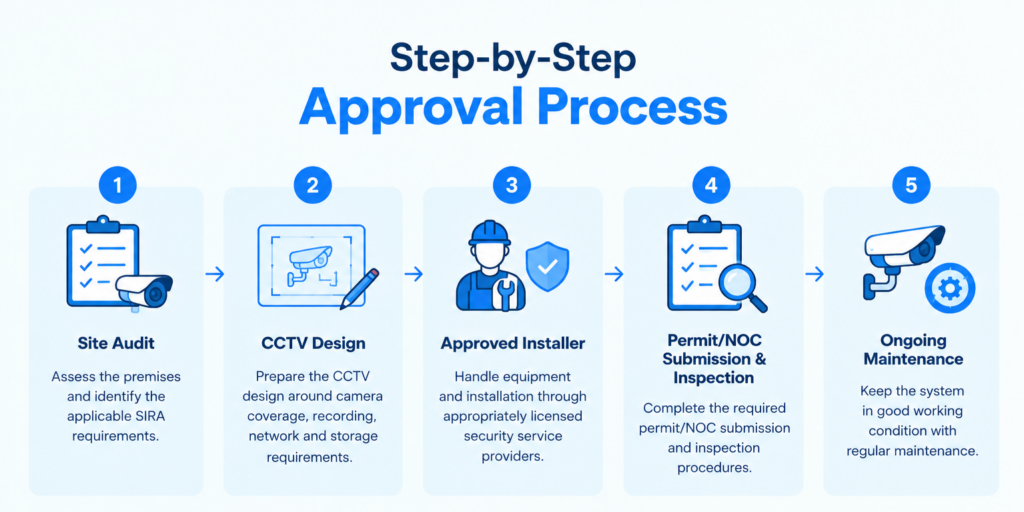
Step-by-Step Approval Process
Common Compliance Mistakes to Avoid
Businesses often focus only on purchasing high-resolution cameras, but compliance issues usually come from elsewhere in the system:
- Choosing the wrong camera position
- Inadequate storage capacity
- Poor network design
- Unsuitable outdoor equipment
- Working with an unlicensed provider
This is why selecting experienced Top ELV companies in Dubai is important when designing or upgrading a SIRA-compliant system.
SIRA vs. MCC/ADMCC – A Common Confusion Solved
SIRA pertains to security regulations in Dubai, whereas Abu Dhabi complies with its own requirements based on the relevant Abu Dhabi regulatory system. Companies that are doing business in both states must not believe that they can meet the requirements of one emirate and be assured of satisfying those of the other.
| Category | SIRA (Dubai) | MCC/ADMCC (Abu Dhabi) |
|---|---|---|
| Governing framework | Dubai Law No. 12 of 2016 | Abu Dhabi security framework |
| Regulator | SIRA | MCC/ADMCC |
| Minimum resolution | 1080p Full HD | Depends on applicable requirement |
| Outdoor rating | IP66 where specified | Depends on applicable requirement |
| Retention | Requirements vary by facility; 31 days specified in applicable requirements | Depends on facility/category |
| Network standard | Dedicated security network and related requirements | Depends on applicable standard |
| Compliance | Inspection and regulatory approval requirements apply | Separate Abu Dhabi approval requirements apply |
Businesses should always verify the requirements applicable to their specific premises rather than relying on generic CCTV specifications or older online guides.
How Can Businesses Stay SIRA Compliant in 2026?
In 2026, SIRA CCTV compliance entails more than merely putting in cameras. At present, the preventive systems manual outlines quantifiable specifications such as 1080p resolution, 25 FPS real-time monitoring, 48dB signal-to-noise ratio, IP66 weatherproof rating, 110 dB WDR, and 20% extra storage.
Companies looking to set up new installations or upgrade existing installations must evaluate SIRA guidelines before purchasing their equipment to avoid unnecessary expenditure later. Partnering with an ELV and security systems provider with experience will help ensure that the CCTV infrastructure is tailored to the specific needs of the premises.
Recent Blogs
- Endpoint Detection Response (EDR)Solutions to Check Endpoint Threats
- A Well Planned IT Infrastructure is Essential For Running Your Business
- Why You Should Induct Process Automation into Your Business
- Privileged Access Management (PAM) Solutions to Prevent Unauthorised Privileged Access
- Do You Want to Achieve Business Growth with Digital Transformation Services in UAE?
- Do You Want to Revolutionize Customer Experience?
- Do You Want to Propel Your Business Growth with Cutting-Edge Solutions?
- Empowering Your Business With Cloudlink Solutions Digital Transformation Services
- Enhancing Cyber Resilience with Email Security Services in Dubai
- Cloudlink IT Solutions: Empowering Businesses with Advanced Automation Software
- WazirX Hack: A $235 Million Crypto Catastrophe Shocks India
- Fortifying Your Business with Robust Cybersecurity Solutions
- Shielding Your Business: A Comprehensive Guide to Endpoint Security
- How Phishing Attacks Quickly Adapt to Bypass Security Measures | Cloudlink
- Critical Security Flaws in Industrial Automation Software | Cloudlink Solutions
- The Rising Threat of Contactless Payment Fraud | Cloudlink IT Solutions
- Enhancing Cyber Resilience with Leading Email Security in UAE | Cloudlink IT Solutions
- Why Every UAE Company Needs a Robust Cybersecurity Strategy
- Demystifying Cybersecurity in Dubai: An Overview of the Threat Landscape
- Digitally Transformed Dubai | Cloudlink IT Solution
- The Growing Importance of Cyber Security in Todays Business Environment
- What Role Does a Cyber Security Company Play in Today’s Digital World?
- Is Your IT Infrastructure Prepared for Cyber Threats in Dubai?
- Is Investing in Cyber Security in Dubai Worth It for My Business?
- What is the Current State of Cybersecurity in Dubai?
- Don’t Wait for a Breach: Are You Proactive About Cyber Security?
- From Ransomware Defense to Cloud Protection
- What Is Cyber Security and Why Should It Matter to Your Business?
- In the Market for a Cyber Security Company in Dubai? See Why Cloudlink Is Your Top Choice
- How Cyber Security Services in the UAE can Secure Your Digital Assets
- Why Zero Trust Architecture Is Critical for Remote and Hybrid Workforces in 2025
- How Quantum Computers Could Break Today’s Encryption Systems
- How to Detect Fileless Malware with Modern Security Tools
- A Beginner’s Guide to Malware Threats and How to Protect Your Systems
- Best EDR Tools for Detecting Fileless Attacks in 2026
- EDR vs XDR Explained: What Businesses Need to Know
- Advanced Persistent Threats (APTs): Everything You Need to Know
- Understanding Wiper Malware and How to Stay Protected
- How the UAE Central Bank’s New Directive Is Redefining Brand Protection and Digital Risk
- IT AMC vs In-House IT Support: Which is Better?
- SIEM vs Traditional Security Tools: What Modern Businesses Need in 2026
- Different Types of CCTV Cameras Explained: A Complete Guide for Businesses
- Structured Cabling Explained: Components, Benefits, and Business Use Cases
- What Is a SOC? A Practical Guide for Business Owners and IT Managers
- Understanding Different Types of SOC Models: A Practical Guide for Businesses
- Advantages of Managed SOC Services in Dubai for Small Businesses
- Rise of AI-Powered Scams in the UAE: What Businesses Need to Know
- VAPT Services for Businesses: A Guide to Vulnerability Assessment and Penetration Testing
- SIRA CCTV Standards in the UAE: What’s Updated in 2026
- Vulnerability Assessment vs Penetration Testing: Key Differences
- VAPT for SaaS Applications: Security Testing for Multi-Tenant Cloud Platforms